Queue Management System in Pakistan: The Complete 2026 Buyer’s Guide
From crowded bank branches in Karachi to busy hospital reception desks in Lahore, waiting lines are a daily reality for millions. In 2026, a modern queue management system in Pakistan is transforming that reality — replacing chaotic crowds with orderly, notified, and measurable service. Businesses that adopt digital queuing are seeing shorter waits, calmer staff, and customers who actually come back.
This buyer’s guide covers how the technology works, which sectors benefit most, what to budget, and how to choose a vendor. If you want the deep-dive on modules and deployment, the queue management system in pakistan resource is an excellent companion read.
Why Pakistani Businesses Are Adopting Digital Queuing
Urban service points are under pressure. Rising populations in major cities, expanding banking access, and a growing middle class all funnel more people through the same counters. Manual lines simply cannot cope.
The shift is driven by clear pain points:
- Overcrowding during peak hours at banks, telecom centers, and clinics.
- Customer frustration from unclear, unfair waiting.
- No data for managers to plan staffing.
- Lost business as impatient visitors leave.
Global bodies that study public service delivery, including the OECD governance program, consistently link transparent, predictable processes with higher trust and satisfaction — exactly what digital queuing delivers.
How Does a Queue Management System Work?
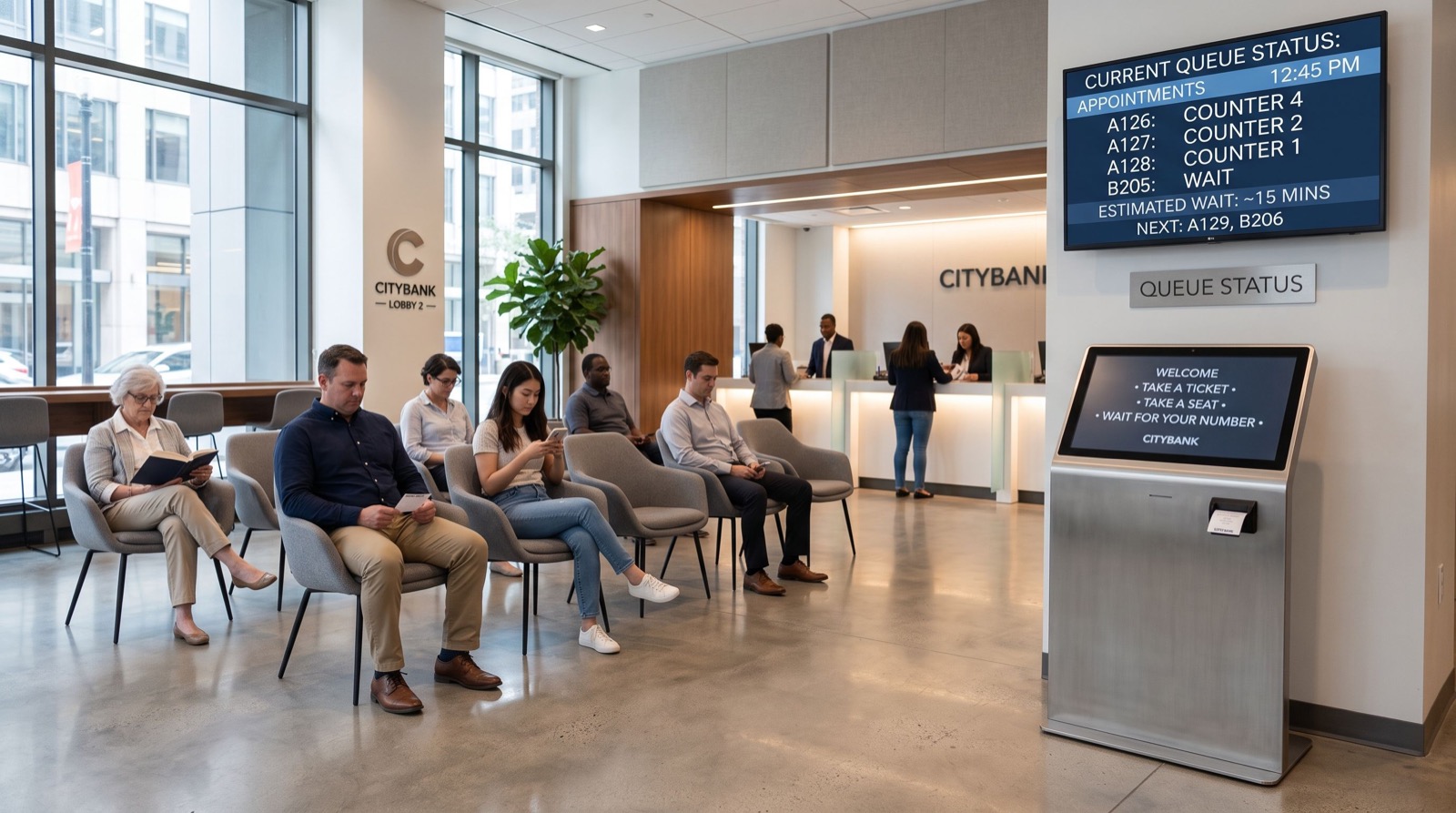
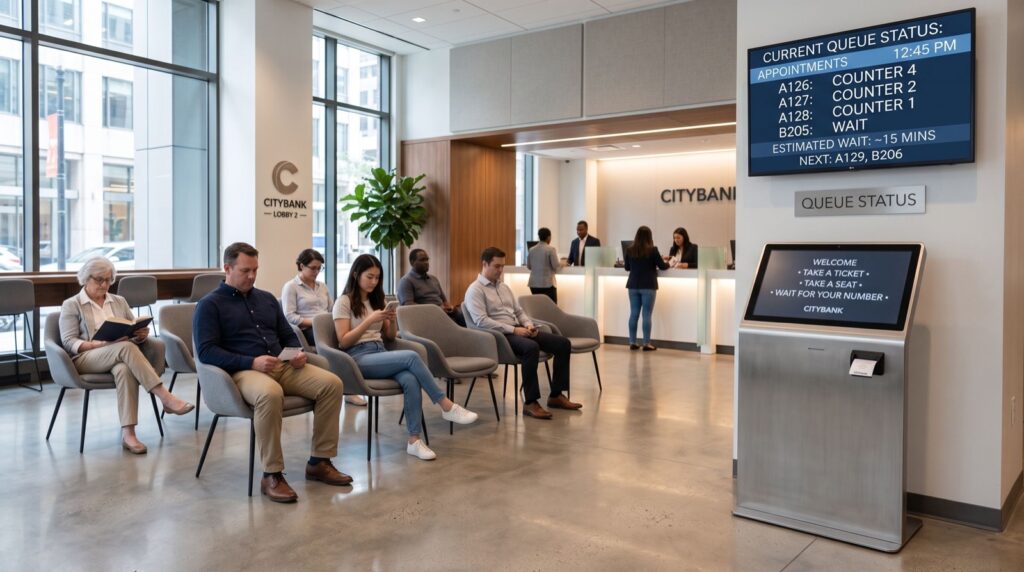
The experience is simple for the customer and powerful for the manager. A visitor takes a ticket from a kiosk, a QR code, or a mobile app; the system routes them to the correct counter; screens and audio call their number; and every step is logged for analysis.
The core components are:
- Check-in: kiosk, mobile, or online appointment.
- Smart routing: rules match the visitor to the best-suited counter.
- Displays and audio: Urdu and English announcements guide customers.
- Agent tools: staff call, transfer, recall, and close tickets.
- Analytics: live and historical reports on waits, volumes, and no-shows.
Sectors Winning With Queue Management in Pakistan
Banking
Branches route cash, account services, and corporate clients to specialized tellers, cutting handling time and raising throughput.
Healthcare
Hospitals separate registration, consultation, pharmacy, and billing so patients never wait in the wrong line.
Telecom and Retail
Service centers use appointment booking and SMS alerts to flatten peak rushes and improve the in-store experience.
Quick-Service Restaurants
Fast-food chains extend the same speed to their exterior lanes. Pairing in-branch queuing with a proven HME drive thru in saudi arabia solution shows how order accuracy and rapid service scale across borders and channels.
Feature Comparison: Basic vs. Enterprise
| Feature | Basic Package | Enterprise Package |
|---|---|---|
| Ticketing | Single kiosk | Kiosk + mobile + online |
| Notifications | Screen only | SMS + app alerts |
| Branches | One | Unlimited, centrally managed |
| Analytics | Basic reports | Live dashboards + export |
| Languages | Urdu/English | Multilingual + RTL |
What Should You Budget?
Cost depends on hardware, branch count, and cloud versus on-premise hosting. A single-branch starter kit with one kiosk and a display is affordable for small businesses, while multi-city banks and hospital networks invest more for central analytics, mobile check-in, and integrations. Most buyers recover the outlay within the first year through higher throughput and fewer walkaways.
How to Choose the Right Vendor
The platform is only half the decision — support is the other half. Use this checklist:
- Local presence for fast installation and maintenance.
- Urdu and English across tickets, screens, and reports.
- Proven references in your sector.
- Scalable licensing so you can add branches later.
- Integration support for CRM, appointments, and drive-thru.
Choose quality service providers who back the technology with responsive, on-the-ground service — because a queue system that fails at 10 a.m. on payday helps no one.
Cloud vs. On-Premise: Which Deployment Fits Pakistan?
One of the first decisions buyers face is where the system lives. Both models work well; the right choice depends on your branch count, IT resources, and data policy.
| Factor | Cloud Deployment | On-Premise Deployment |
|---|---|---|
| Upfront cost | Lower — subscription based | Higher — servers required |
| Scaling branches | Instant | Manual setup per site |
| Maintenance | Handled by vendor | Your IT team |
| Data control | Hosted, encrypted | Fully in-house |
| Best for | Multi-branch chains | Strict local-data needs |
Fast-growing telecom and retail chains usually favor cloud for its speed and low entry cost, while some banks and government bodies choose on-premise to keep sensitive records inside their own walls.
Real-World Impact: What Changes After Go-Live
The transformation is visible within days. Instead of a crowd pressing toward a single counter, visitors take a ticket, sit down, and wait for an SMS or a screen call. Staff stop refereeing disputes over who arrived first and focus on serving people.
Managers gain something they never had before: proof. They can finally answer questions like which hour is busiest, which counter is slowest, and how many customers left without being served. Armed with that evidence, they schedule staff against real demand rather than tradition.
Over a full quarter, the pattern repeats across sectors — shorter waits, fewer walkaways, higher satisfaction, and a calmer, more confident team. These are not abstract promises; they are the routine outcomes of turning a hidden process into a measured one.
Customers notice the change too. A visitor who once dreaded a trip to the bank or clinic now knows they can check in, step away, and return when their phone buzzes. That single shift — from anxious standing to relaxed waiting — is often what turns a one-time customer into a loyal, repeat one.
A Practical Rollout Tip
Pilot in your busiest branch, not your quietest. It is tempting to test somewhere low-risk, but only a high-traffic location reveals the real bottlenecks. Run it for two weeks, tune the routing rules with actual data, then replicate the proven setup across the network.
Frequently Asked Questions
What is the best queue management system in Pakistan for banks?
Banks should prioritize smart routing, appointment booking, SMS alerts, and central multi-branch dashboards, all with full Urdu and English support.
Does a queue management system support Urdu?
Yes. Reputable platforms provide Urdu alongside English on kiosks, displays, audio calls, and management reports.
How long does installation take?
A single branch is usually live within a few days including staff training, while multi-branch rollouts are staged over several weeks after a pilot.
Can it integrate with a drive-thru?
Yes. The same platform can unify in-branch queues with drive-thru lanes, giving managers one view of service performance across channels.
Conclusion
In 2026, customers expect fast, fair, and predictable service everywhere they go. A well-chosen queue management system in Pakistan delivers exactly that — turning crowded, stressful lines into an orderly experience while handing managers the data to keep improving. From a single clinic to a nationwide bank, the benefits are immediate and lasting.
Ready to modernize your service? Request a demo, run a pilot in your busiest branch, and start cutting wait times before your next peak season.